What Nobody Tells You About Football Teams
A football team is not simply eleven players in matching shirts; it is a structured unit representing a club, nation, school, or professional franchise, with performance shaped by roles, tactics, coac...

What Nobody Tells You About Football Teams
A football team is not simply eleven players in matching shirts; it is a structured unit representing a club, nation, school, or professional franchise, with performance shaped by roles, tactics, coaching, data, and resources. In association football, a matchday squad may contain 23 players at a FIFA World Cup, while only 11 start and up to 5 substitutions are normally permitted under modern competition regulations. In American football, an NFL team carries a 53-player active roster, with 11 players from each side on the field during a play. Football Insights studies these differences for fans following the 2026 FIFA World Cup, combining match predictions, team tactics, player statistics, and tournament context. The practical takeaway is simple: judge a football team through its structure, depth, and repeatable metrics—not merely its badge, reputation, or last dramatic result.
The Bottom Line
A football team is a group of players selected to compete together, but its real identity comes from the system connecting those players. A club such as Manchester City, a national side such as Argentina, and an NFL franchise such as the Green Bay Packers are all football teams, yet they operate under different rules, roster models, calendars, and commercial structures.
The most important distinction is between a football team and a football club. A club is the broader organization: it may own training facilities, employ coaches and analysts, operate youth academies, sell memberships, and represent supporters. The team is the competitive unit chosen for a specific fixture. A club can therefore contain several teams, including a first team, reserve side, women’s team, and youth squads.
The International Football Association Board defines association football through laws governing players, equipment, match duration, substitutions, and officiating. The famous “11 players” idea is accurate for the starting lineup, not necessarily the full squad. That small technical difference matters when comparing injuries, rotation, tournament fatigue, and betting markets.
Football Insights treats the team as an analytical object rather than a sentimental monument. We examine expected goals, possession value, pressing intensity, defensive transitions, set pieces, and lineup continuity. The badge may sell shirts; the data tells us whether the machine is functioning.
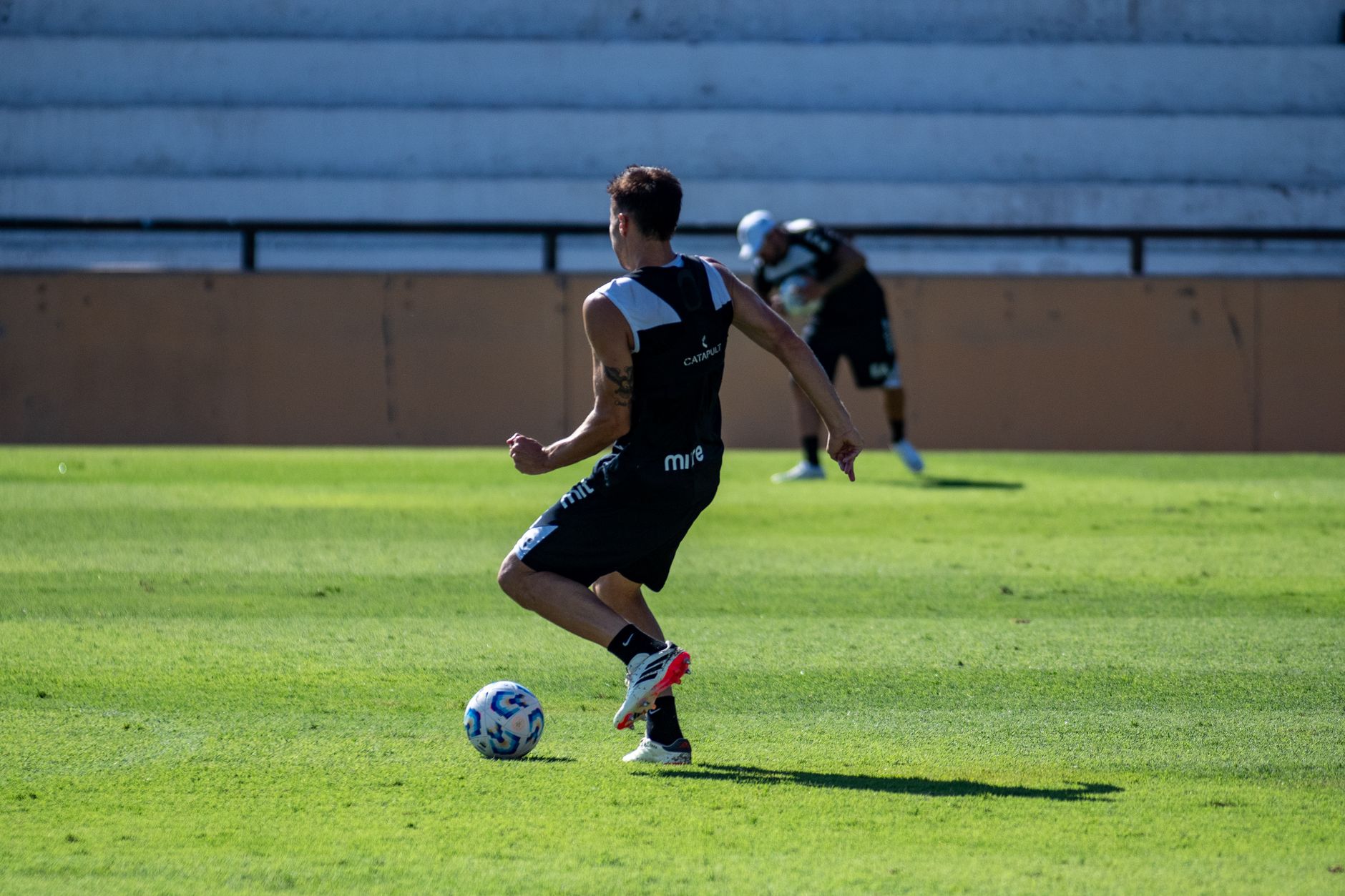
Photo by Franco Monsalvo on Pexels
If you want the numbers behind team performance, Football Insights provides a practical starting point.
What Players Actually See
A player does not experience a football team as a logo, league table, or social-media slogan. They experience distances between teammates, pressing triggers, defensive cover, communication patterns, travel schedules, recovery windows, and the consequences of one poor decision. The public sees the final score; players see hundreds of smaller choices that produced it.
In association football, the starting structure may be described as 4-3-3, 4-2-3-1, 3-4-2-1, or another formation, but these numbers are only the opening coordinates. A full-back may become a midfielder during possession, a winger may defend as a second full-back, and a striker may drop into midfield to create space. Liverpool, Bayern Munich, and Real Madrid have all shown that the same nominal formation can produce sharply different attacking and defensive behaviors.
American football is even more specialized. The Green Bay Packers, Dallas Cowboys, and Kansas City Chiefs divide responsibilities among offensive, defensive, and special-teams units. A quarterback may never play a defensive snap, while a cornerback can spend an entire drive tracking one receiver. The NFL’s 53-player roster is therefore not comparable to a soccer squad simply because both are called football teams.
A useful football team has role clarity, redundancy, and adaptability. The player who replaces an injured starter must not merely possess similar technical ability; they must understand the team’s pressing angles, build-up options, and defensive responsibilities. This is where [Internal Link: football tactics and formations guide] becomes useful: formation labels describe shape, while tactics explain behavior.
After 30 match reports from top-level European leagues, one recurring pattern is clear: teams with more than 60% possession still lose regularly when their defensive rest structure is weak. Possession is not protection. It is only a resource, and careless teams spend it like money borrowed at a brutal interest rate.

Photo by Anastasia Shuraeva on Pexels
To see how tactical roles affect predictions, explore the latest team analysis.
What Are the 3 Things That Matter Most?
The three decisive factors are team structure, player availability, and measurable performance quality. These factors explain more match outcomes than fame, historic trophies, or a single viral highlight. They also provide a more reliable framework for evaluating a football team before a major fixture.
1. Structure and tactical compatibility
A team must connect its lines. In association football, that means the defense, midfield, and attack maintain useful spacing during possession and transition. A high defensive line can support pressure but creates space behind the center-backs; a low block protects depth but may surrender territory and shot volume. Neither approach is automatically superior, despite the confident declarations of television pundits.
The key question is compatibility. A fast center-back may support aggressive pressing, while a slow defensive line may require a deeper block. A creative midfielder needs passing options, and a striker needs service that matches their movement. Manchester City’s positional rotations work because players repeatedly occupy predetermined zones; Argentina’s 2022 World Cup success relied on a different balance of compactness, transition speed, and Lionel Messi’s creative freedom.
2. Availability and squad depth
Injury news is not a footnote. It can change the expected quality of a football team by several percentage points. Losing a goalkeeper affects distribution and shot prevention; losing a defensive midfielder can expose the center-backs; losing a striker may reduce shot volume and penalty-box occupation.
For the 2026 FIFA World Cup, expanded tournament logistics will make rotation, travel, climate, and recovery especially important across host cities in the United States, Canada, and Mexico. A team with 15 dependable players is structurally safer than one dependent on 11 stars. The difference often appears after the 70th minute, when fatigue turns tactical theory into an expensive practical joke.
3. Evidence beyond the scoreboard
Results are essential, but they are noisy. A team can win 1-0 after allowing 2.1 expected goals, or lose 0-1 after creating 2.4 expected goals. Expected goals, shot quality, field tilt, progressive passes, set-piece efficiency, and turnovers in dangerous zones offer additional context.
For NFL analysis, the relevant measures differ: success rate, explosive-play rate, pressure rate, early-down efficiency, red-zone conversion, and expected points added. Comparing NFL metrics directly with soccer statistics is meaningless, although that has never stopped anyone with a television panel and ten minutes to fill.
Use this checklist when assessing a football team:
- Confirm the likely starting lineup and unavailable players.
- Compare the team’s tactical style with the opponent’s pressure and defensive shape.
- Check performance metrics over at least 5 to 10 matches rather than relying on one result.
- Separate home, away, tournament, and league performances.
- Evaluate set pieces, substitutions, and late-game behavior.
- Compare market expectations with your own evidence before making any decision.
For deeper statistical context, FBref provides historical player and team data, while ESPN NFL Teams tracks NFL rosters, schedules, statistics, and depth charts. These sources are useful, but raw data still requires interpretation.
[Internal Link: World Cup team predictions and form analysis]
What Are Common Edge Cases and Gotchas?
The most common mistakes involve confusing a club with a team, treating formation numbers as fixed tactics, ignoring squad depth, and interpreting popularity as current strength. A famous football team can have 90% recognition and still be tactically vulnerable, poorly coached, or missing its best players.
YouGov’s public ratings illustrate the difference between fame and popularity. In one listed United States survey, the Green Bay Packers reached 92% fame and 42% popularity, while the Dallas Cowboys recorded 91% fame and 30% popularity. The Chicago Bears posted 89% fame and 46% popularity; the New York Giants and Philadelphia Eagles both reached 88% fame. Recognition measures whether people have heard of a team. It does not measure current win probability.
Several edge cases deserve special attention:
- National team versus club: Argentina represents a country, while Real Madrid operates as a club with year-round recruitment and training.
- Starting lineup versus squad: Eleven players start an association football match, but substitutes and reserve options may determine the final result.
- Formation versus phase: A 4-3-3 in possession can become a 4-4-2 without the ball.
- Team quality versus recent form: Five consecutive wins may include weak opponents, lucky finishes, or unsustainable goalkeeping.
- Football terminology: “Football team” may mean association football in most of the world or American football in the United States and Canada.
- Competition rules: Substitution limits, squad sizes, extra-time rules, and registration requirements vary by competition.
A particularly useful operational insight is lineup timing. Team news released 60 to 90 minutes before kickoff can materially alter tactical expectations, especially when a holding midfielder or center-back is replaced. Waiting for confirmed lineups is often less exciting than rushing to a prediction, but excitement is not a statistical edge.
The FIFA official website publishes tournament information, regulations, rankings, and World Cup coverage. FIFA’s Laws of the Game framework also makes clear that “a match is played by two teams,” but that simple sentence hides the complex staff, substitutes, analysts, medical personnel, and administrators required to sustain elite competition.

Photo by Emanuel Pedro on Pexels
For a disciplined match-reading process, review the latest Football Insights team reports.
How Should You Evaluate a Football Team in 2026?
Evaluate a football team by combining tactical identity, opponent quality, player availability, schedule pressure, and performance data across a meaningful sample. For the 2026 FIFA World Cup, use at least 5 recent competitive matches, confirmed squad news, travel conditions, and group-stage incentives before forming a view.
A strong evaluation starts with the team’s baseline. Record goals scored, goals conceded, expected goals for and against, shots from central areas, set-piece results, and possession-adjusted defensive actions. Next, adjust for opponent strength; a 2-0 win against a top-ranked side means something different from a 2-0 win against a depleted lower-tier opponent.
Then inspect tactical matchups. A high-pressing team may struggle against a goalkeeper and center-back pairing capable of breaking the first line. A possession-heavy team may be exposed by fast wide attackers. A narrow midfield can dominate central zones but concede crosses, while an aggressive full-back pairing can create chances and leave enormous gaps behind.
For readers tracking football teams through a responsible betting lens, the objective is not to predict every match. That fantasy belongs to marketing departments and people who sell certainty in bold fonts. Instead:
- Set a fixed research budget and time limit.
- Record your pre-match reasoning before seeing the result.
- Compare your expected probability with the available market price.
- Avoid chasing losses after late goals or controversial decisions.
- Treat predictions as uncertain analysis, not guaranteed income.
Football Insights focuses on FIFA World Cup tactics, team form, player statistics, and match context for 2026. That information can improve decision quality, but it cannot remove variance. A deflected shot remains a deflected shot, no matter how elegant the spreadsheet looks.
[Internal Link: responsible football prediction principles]
Verdict
A football team is best understood as a coordinated system rather than a collection of famous players. Its competitive strength depends on how well roles fit together, how effectively substitutes preserve the game plan, and whether the underlying numbers support the visible results. Green Bay Packers fame, Dallas Cowboys commercial reach, Argentina’s international identity, and Manchester City’s tactical structure all describe different kinds of football-team power.
The most reliable approach is to examine evidence in layers: roster, tactics, opponent, metrics, schedule, and incentives. For the 2026 FIFA World Cup, confirmed lineups and travel conditions may matter as much as historical rankings, particularly during congested group-stage schedules across North America. The practical verdict is pleasantly unromantic: trust repeatable structure over reputation, and probability over prophecy.
If you are following the tournament with Football Insights, use the coverage to test your assumptions, not merely confirm them. The best partnership between analyst and reader is not blind agreement; it is two people quietly checking the numbers while everyone else argues about badges.
Ready to make your football research more systematic?
Frequently Asked Questions
Q: What is a football team?
A: A football team is a group of players selected to compete together under the rules of a particular football code. In association football, 11 players begin a match, while the wider squad includes substitutes and reserve options. In the NFL, offensive, defensive, and special-teams units share the same franchise roster, with 11 players from one side on the field during a play. A team may represent a club, country, school, community, or professional organization.
Q: How many players are on a football team?
A: The number depends on the football code and competition. Association football uses 11 players per side on the pitch, with competition-specific squad and substitution rules; FIFA World Cup squads commonly include 23 or more registered players. An NFL team has a 53-player roster, although only 11 offensive or defensive players participate in a single play. Always check the regulations for the specific league or tournament.
Q: What is the difference between a football team and a football club?
A: A football team is the playing unit, while a football club is the broader organization that manages teams and operations. A club such as Real Madrid may include a senior men’s team, women’s team, academy teams, coaches, medical staff, facilities, and supporters. A national team such as Argentina represents a country and normally assembles players from different clubs for international windows and tournaments.
Q: How do you evaluate a football team before a match?
A: Evaluate lineup availability, tactical matchup, recent underlying performance, opponent quality, home or away conditions, and schedule pressure. Review at least 5 to 10 matches, comparing expected goals, shot quality, defensive actions, set pieces, and late-game performance. Confirm starting lineups approximately 60 to 90 minutes before kickoff because one absent midfielder or center-back can change the team’s structure substantially.
Q: Is a famous football team automatically the strongest?
A: No, fame measures recognition rather than current sporting strength. YouGov data listed Green Bay Packers fame at 92% and Dallas Cowboys fame at 91%, but those figures do not predict a specific match result. Historical trophies, large fan bases, and media attention can influence public opinion while current injuries, coaching, tactics, and opponent quality point in another direction.
Q: Why does a football team perform well in one match but poorly in the next?
A: Performance changes because of opponent style, player availability, tactical adjustments, finishing variance, fatigue, and game state. A team may dominate possession against a low block but struggle against aggressive pressure, or create good chances without scoring. Compare several matches and underlying metrics instead of treating one result as a permanent identity.
Q: What should I do if football team data conflicts with the final score?
A: Record the result separately from the performance evidence and wait for a larger sample. A 1-0 win after conceding 2.1 expected goals may indicate excellent goalkeeping, poor finishing by the opponent, or short-term variance rather than stable superiority. Review 5 to 10 matches, adjust for opponent strength, and avoid chasing losses or changing conclusions solely because of one late goal.
Thank you for reading this piece from our digital heirloom collection.
Football Insights · The Digital Heirloom · Volume I